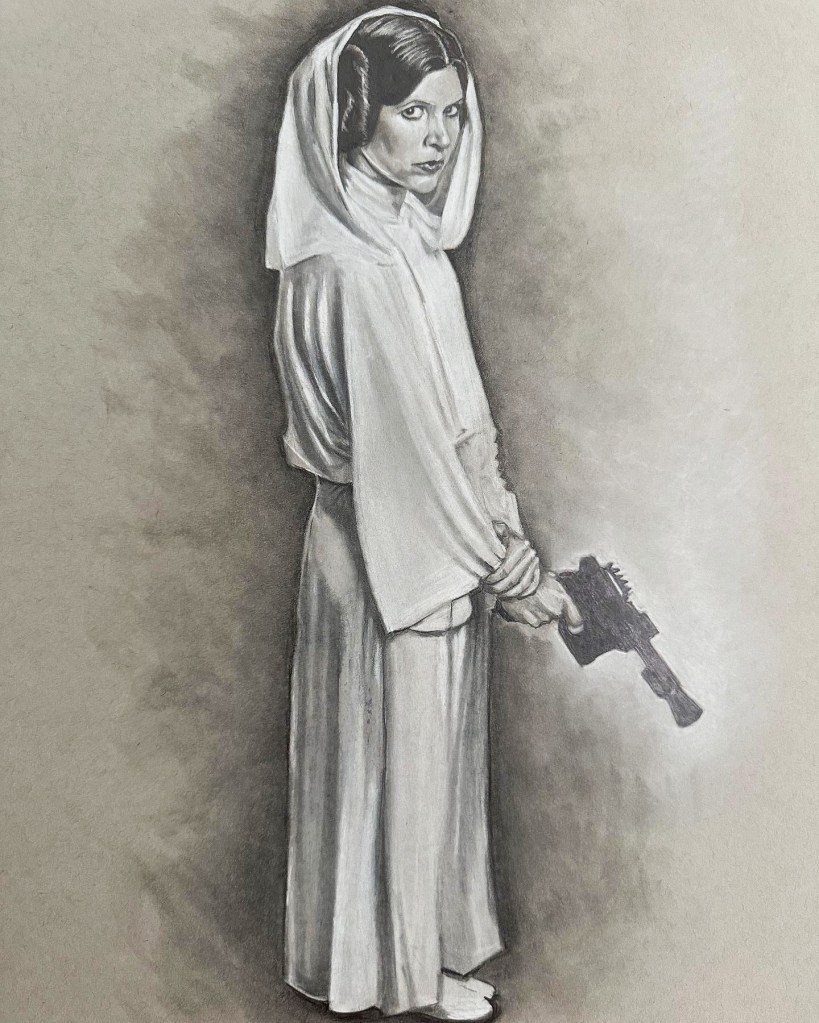
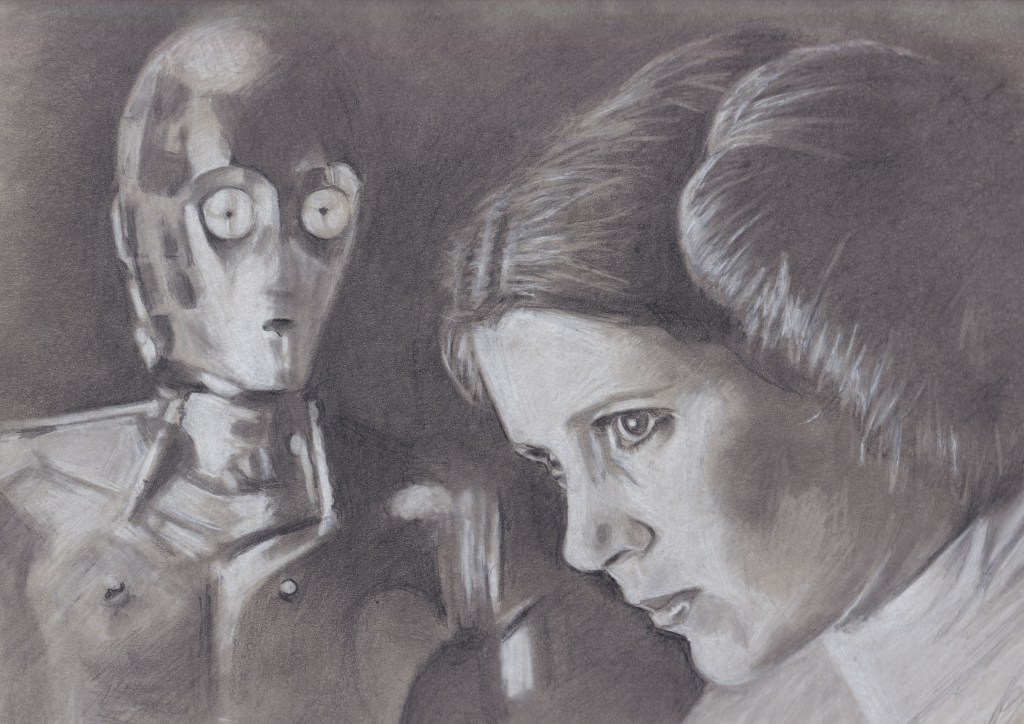
Fierce, intelligent, courageous, and principled –and generally the only one in a room who knew what was going on, Leia is the soul of the Rebellion. While so much like her mother in political acumen and moral strength, bursts of Anakin shine through in her passionate defense of her friends.
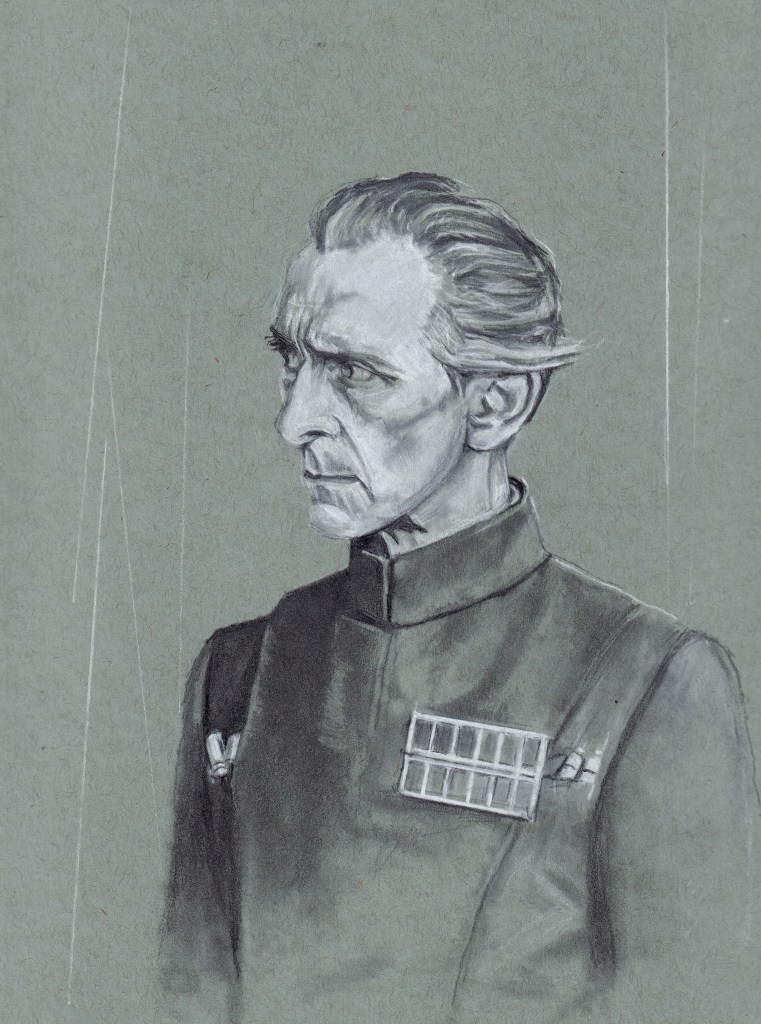
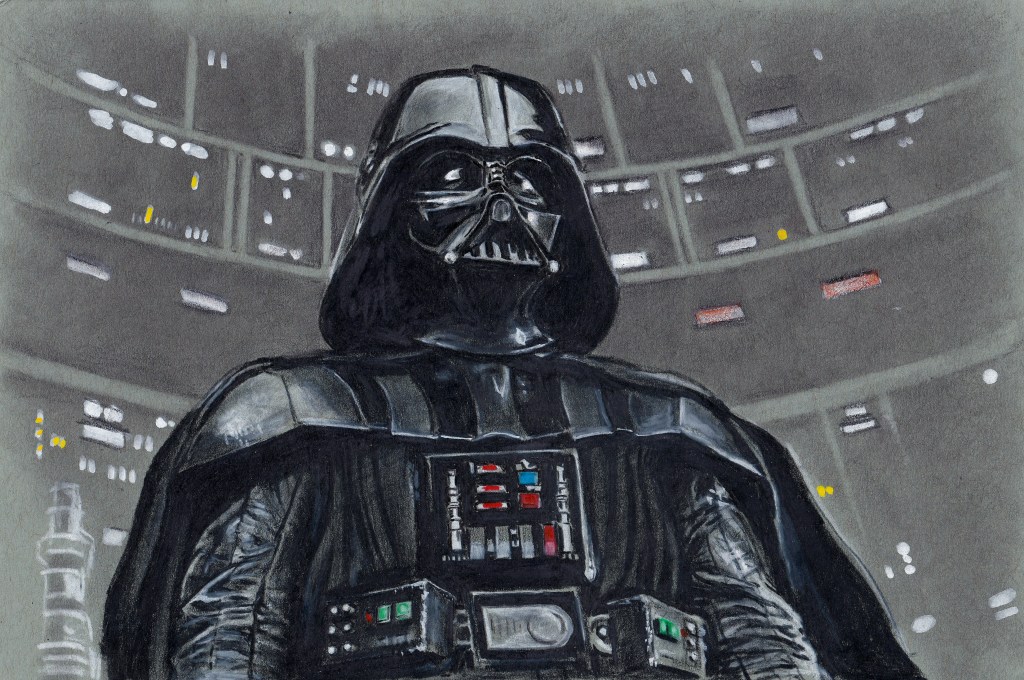
Echoing the Third Reich, replete with Stormtroopers, a mechanized brutality, and an obsession with order and hierarchy, the Galactic Empire demonstrates an unmistakable historical fascism.
Thematically following Lucas’ nod to WWII, I wanted to sketch Tarkin as he might appear in a military photograph of the 1940s. Here, Tarkin’s furrowed brow deceives us. Care and even anxiety may be deciphered on his face, but it’s the concern for functionality –the middling worry of diminished position, that his place in hierarchy may be disrupted, that his trust in Vader may be misplaced, that, as Vader replies to Moff Jerjerrod in Return of the Jedi: ‘The Emperor is not as forgiving as I am.”
Moreover, Peter Cushing played a delightfully wicked Tarkin, distilling his roles from Hammer horror films into the ruthless military governor, whose slightest word would end the lives of billions.

Qui-Gon is my favorite Jedi. I adore Luke, respect Obi-Wan and Yoda, and think Mace is the most skilled with the saber. Qui-Gon, however, represents the Jedi as they are meant to be.
He brings humanity to the order. He bases his principles in an unwavering dedication to the light, to the defense of the powerless, and he’s seemingly the only Jedi who cared about Anakin as a child and a human being. Would that he could have lived longer.
While most Jedi are somber and listless, I wanted to depict Qui-Gon in a moment of joy, as he delights in the child Anakin’s playful attitude.
I recommend reading Claudia Gray’s “Master and Apprentice” for its splendid characterization of Qui-Gon.
Here’s one of my favorite Qui-Gon quotes:
“It matters which side we choose. Even if there will never be more light than darkness. Even if there can be no more joy in the galaxy than there is pain. For every action we undertake, for every word we speak, for every life we touch—it matters. I don’t turn toward the light because it means someday I’ll ‘win’ some sort of cosmic game. I turn toward it because it is the light.”
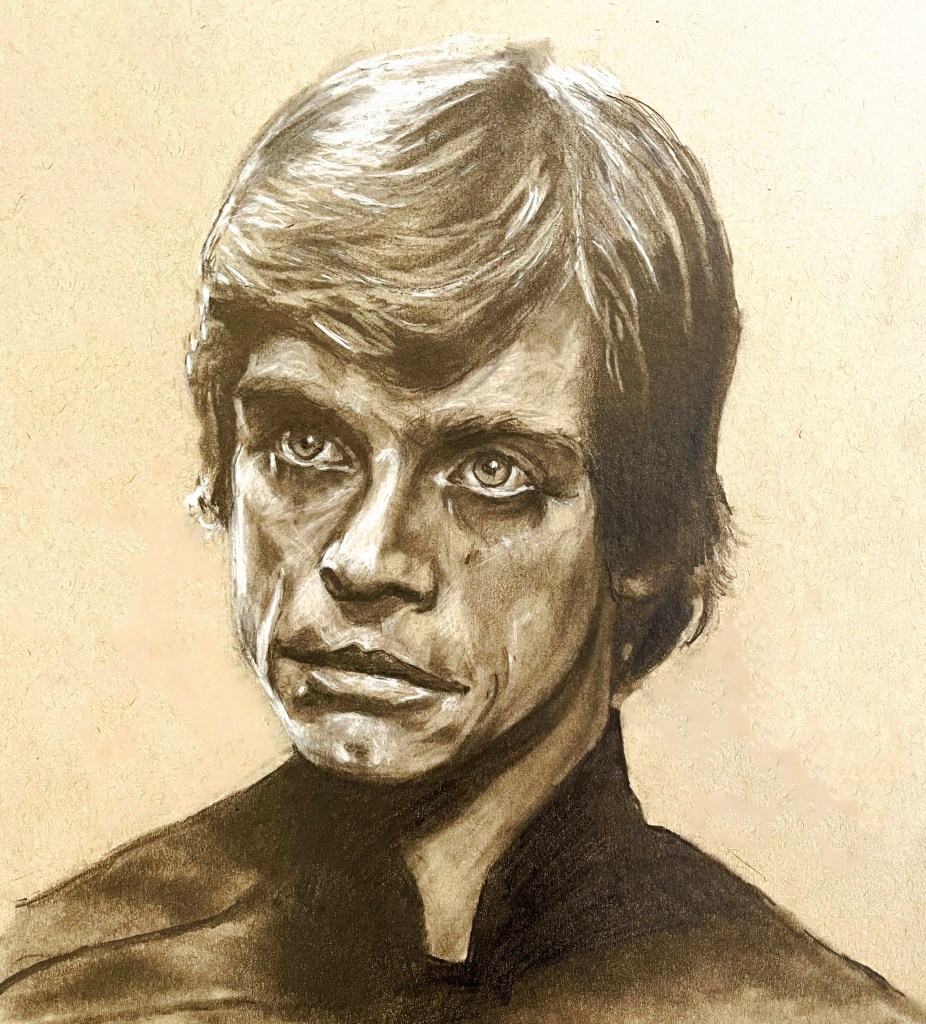

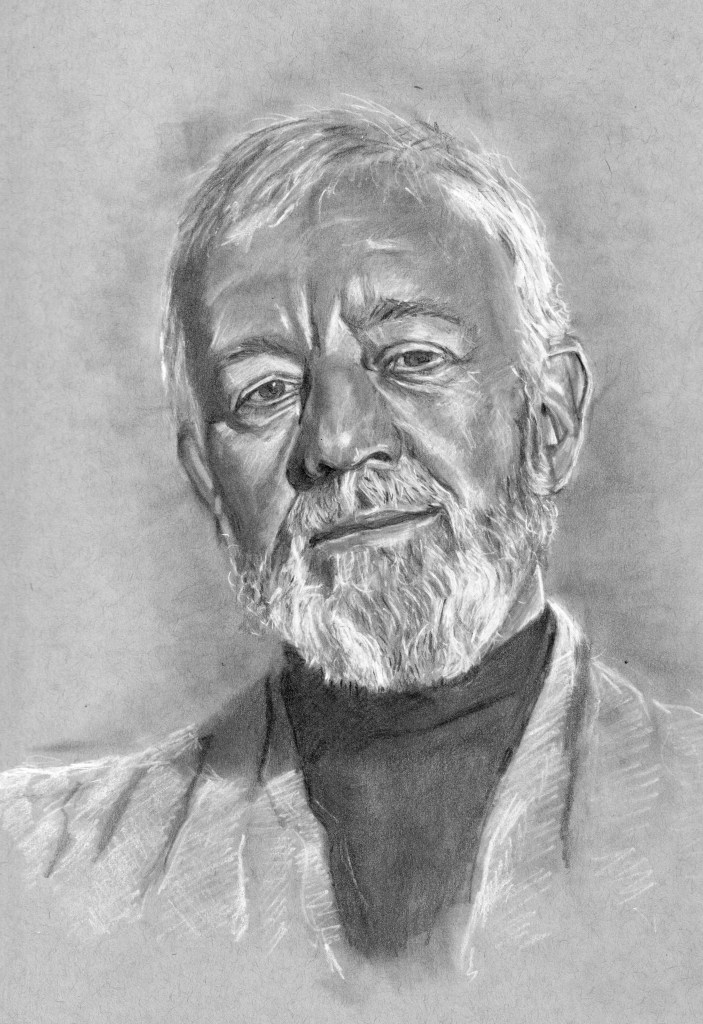
I think it’s important to see Obi-wan as a combat veteran. In this sketch, I wanted to show something of this recollection –a kind smile for lost, happier times, and perhaps a sense of guilt for the current state of the galaxy and the violence that he knows Luke must face.
When only the original trilogy existed, Leia’s revelation that Obi-Wan had served in the Clone Wars set my young mind on fire with speculation. In the near half-century since, Lucas and others have fleshed out Obi-wan’s role in the Clone Wars and detailed the devastating conclusion to that conflict. Yet, here, introduced as Luke’s mysterious sage tutor, Obi-wan becomes the aged combat veteran reflecting on his service in a war his side lost, and thinking about his friend Anakin, the man who had betrayed the Republic, the Jedi Order, his pregnant wife, and had become the Emperor’s enforcer: Darth Vader.


 Chad Carver Art